
Stainless steel strip in spool winding
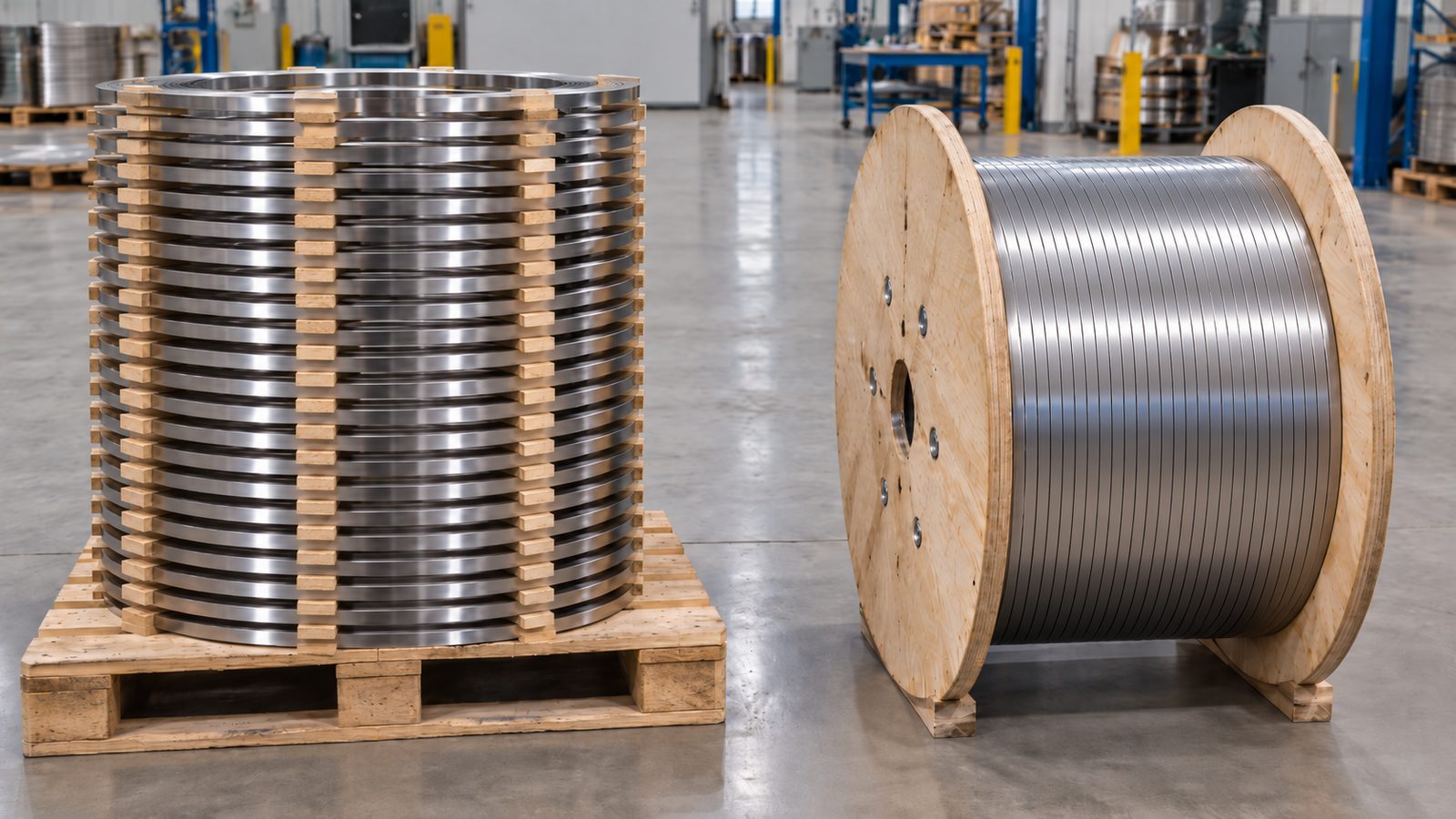
A single coil is used up quickly. Then the line stops, the new coil is threaded in, and the first parts are rejects. On a spool the strip is traverse-wound, layer next to layer like thread on a reel. A core can thus carry a multiple of the strip length, with us up to 1,500 kg per spool.
What the spool changes in production
The line runs for longer because changeovers are less frequent. The start and end of the strip become scrap only once per spool. In the warehouse and at the machine there is one spool instead of many single coils. Because changeovers are less frequent, less threading is needed.
Laser-welded, without interruption
We join the strip with a laser. In our tensile tests on qualified materials and processes, the material usually broke beside the weld seam, not at it. Thickness and mechanical properties at the seam are nearly the same as in the rest of the strip. Whether this also applies to your material and dimension, we clarify before production. As a rule, your production therefore keeps running without interruption. Many customers process the weld seam into the finished part. The seam and the heat-affected zone can have different local properties than the base strip. Use in the finished part requires application-specific approval. On request we mark the seam, so that you can sort out those parts after production.
Calculation example for one year
The strip measures 10 × 0.30 mm. The line is available 7,200 hours a year (three shifts, 300 days) and runs at 25 metres per minute. A changeover takes 10 minutes until the first good part, producing 250 grams of scrap. The changeover time is deducted from the running time.
| Single coil | 500 kg spool | 1,000 kg spool | 1,500 kg spool | |
|---|---|---|---|---|
| Strip length per single coil or spool | approx. 1,500 m | approx. 21,000 m | approx. 42,000 m | approx. 63,000 m |
| Changeovers per year | approx. 6,170 | approx. 510 | approx. 255 | approx. 170 |
| Downtime due to changeovers | approx. 1,030 hours | approx. 85 hours | approx. 43 hours | approx. 28 hours |
| Running time | approx. 6,170 hours | approx. 7,115 hours | approx. 7,157 hours | approx. 7,172 hours |
| Strip processed | approx. 9.26 million m | approx. 10.67 million m | approx. 10.74 million m | approx. 10.76 million m |
| Scrap from changeovers | approx. 1,540 kg | approx. 125 kg | approx. 65 kg | approx. 43 kg |
Compared with the single coil, the spool saves between approx. 940 and 1,000 hours of downtime a year in this example. The same line thus produces 15 to 16 per cent more strip. At a machine hourly rate of €300, that is approx. €280,000 to €300,000. The biggest step is the one from single coil to spool. From 500 to 1,500 kg you gain a further approx. 60 hours.
Calculate with your own figures
Enter your key data. The table calculates immediately. The default values match the example above. We calculate with a fully utilised line and a density of 7.9 kg/dm³.
Please enter a number greater than zero for thickness, width, weight, speed, shifts and days. Shifts at most 3, days at most 365.
Two routes to the spool
With individual spooling, the coils are slit as usual, wound onto the spool one after another and welded together. This is worthwhile for small series and is flexible in terms of width.
With spooling directly from the wide strip, the strip is slit and wound in the same pass. The weld seam runs across the full width before slitting, and the edges are trimmed during slitting. This gives very uniform widths and is worthwhile for large series.
How to process spools
The simplest option is a spool uncoiler. An existing pallet uncoiler or reel for single coils may also be suitable. We check the suitability of an existing uncoiler together with you, based on the manufacturer's approval, in particular for weight, spool width, core and outside diameter, mandrel, guiding and braking.
Spool range
| Characteristic | Range |
|---|---|
| Spool weight | up to 1,500 kg |
| Strip thickness | up to 0.40 mm |
| Strip width | up to 60 mm |
| Core and outer diameter | to your specification |
Switching from single coil to spool
We advise you on spool size and uncoiling equipment and support a trial run.